The gabber look was not designed. It was solved. You dance for hours at 180 BPM in a packed hall: you need clothes that breathe, dry fast and survive. “Dancing 180 bpm for six hours in jeans is a nightmare, but doing it in a loud tracksuit with a shaved head was the height of practicality,” Alberto Guerrini told Rolling Stone Italia (translated from Italian).
Then practical became tribal. The same clothes that worked on the floor became a way to tell everyone on the street who you were and where you went on Saturday. Loud was the point: Guerrini remembers the floor of the Number One near Brescia as “very nineties with lots of fluoro.”
It was about showing your feathers, showing what scene you belonged to and looking tough.
The Aussie
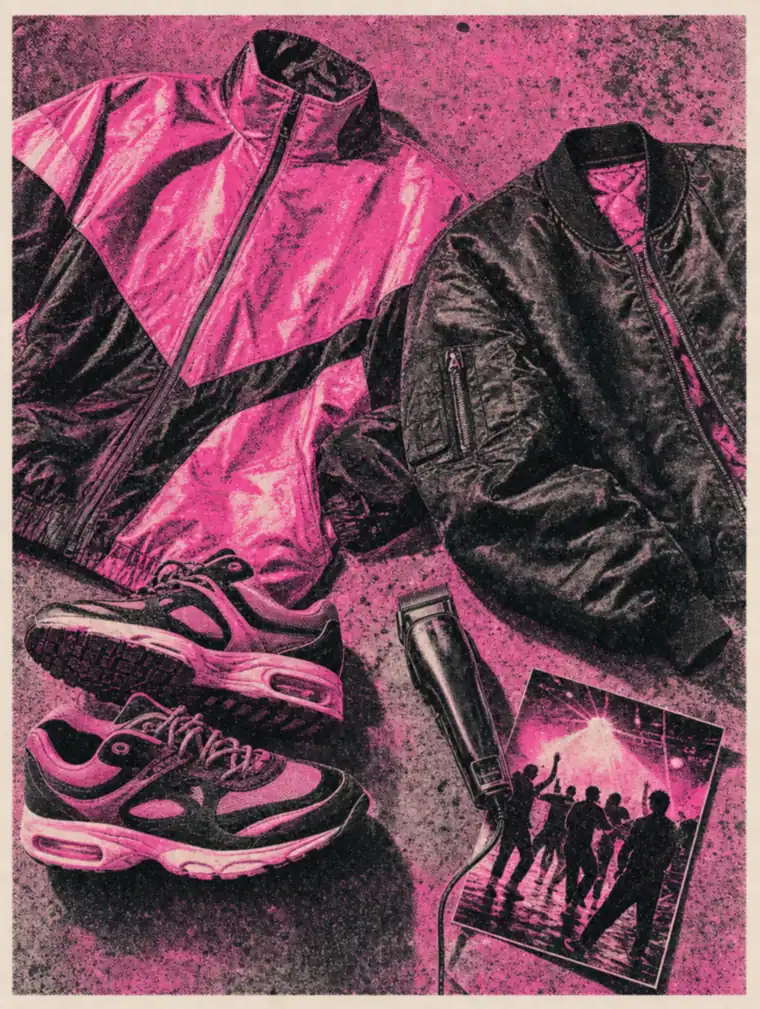
The king of the uniform was the Australian tracksuit, the Aussie. Despite the name, it is Italian: Australian is the tennis line of the Italian company L’Alpina. Bright colour blocks, shiny fabric, a cut made for the tennis court and adopted by the sports hall. For even more colour there was Cavello, whose suits were louder still.
Design Museum Den Bosch calls it the quintessential uniform of the gabber subculture, and it was not cheap. According to the museum, in 1994 a suit cost 500 to 700 guilders, somewhere between 430 and 600 euros in today’s money. That made it a status symbol, and the real show-offs wore two or three jackets layered on top of each other.
Guerrini explains why the price mattered: “The Gabbers wanted to be comfortable, but in a fancy club they were always the outsiders because they’d been wearing cheap clothes.” An expensive Aussie was a working-class kid saying: I belong here, on my own terms.
The big window
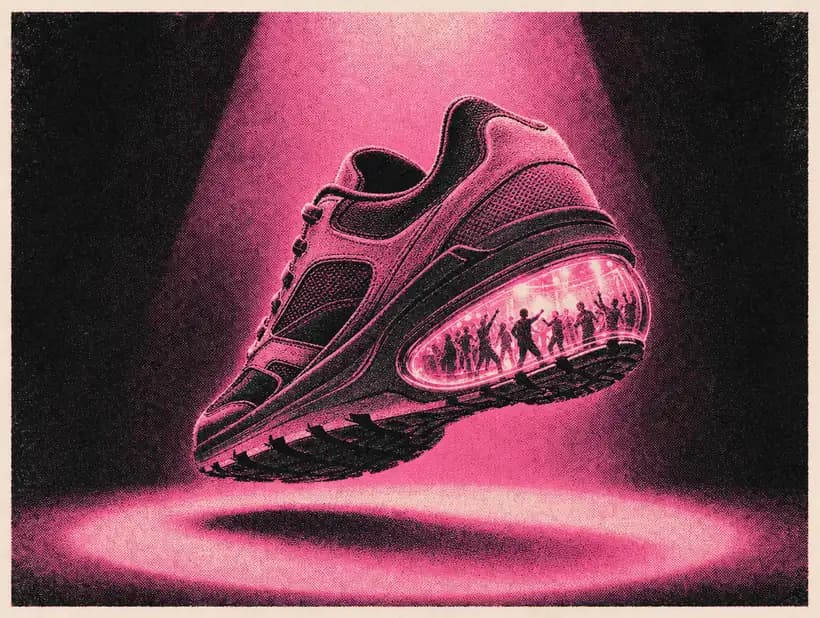
The shoe was the Nike Air Max BW, launched in 1991 with a bigger Air window than the models before it: BW stands for Big Window. In the Netherlands it became so tied to the scene that Design Museum Den Bosch calls it synonymous with gabber, and the Dutch heritage description of gabber culture lists it by its street name, Classics.
Why that shoe? Fit and comfort for nights that could last ten hours, a look that worked well under loose tracksuit trousers, and above all the heel. Hakken lands on the heel, thousands of times a night, and the BW had cushioning exactly where it hurt. Around it went the rest: tracksuit trousers, a T-shirt or nothing at all, and for the street a black bomber jacket.
The BW was never only a gabber shoe, and Boiler Room points out that other subcultures around the world wore it too. But in the Netherlands in the 90s, if you saw a pair under a shiny tracksuit on a Saturday night, you knew exactly where its owner was going.
Heads
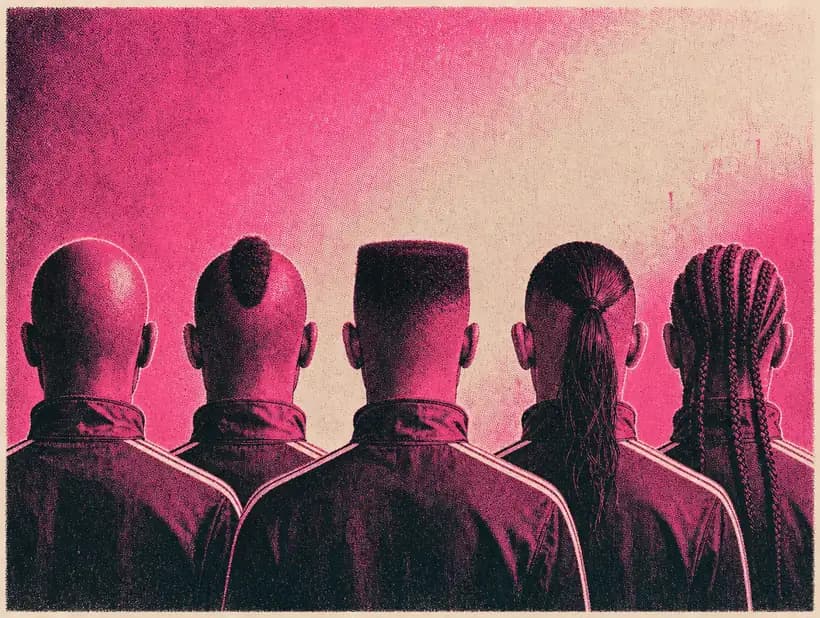
Boys shaved it all off. Girls shaved the sides and the back and kept the rest long, in a ponytail or braids. Boiler Room’s guide to the look lists the cuts by their scene names: baldy, island, blockhead and banana peel for the boys, the undercut with a ponytail for the girls. At Thunderdome 2019 there was even a gabber barber doing undercuts on site.
The girls’ version was every bit as hard as the boys’: shaved sides and back, the rest pulled tight, the same tracksuit and the same shoes, ready for the same dance. Nobody on a gabber floor was there to look delicate.
The shaved head also did something nobody planned. To outsiders, gabbers suddenly looked like skinheads. That was the beginning of a long and lazy misunderstanding, and it brings us to one brand in particular.
The Lonsdale problem
Part of the crowd also wore polo shirts, Fred Perry and Lonsdale. Lonsdale is a London boxing brand founded in 1960, and its problem was four letters: under an open jacket the logo can show only NSDA, one letter short of the initials of Hitler’s party. A small racist minority wore it for exactly that reason. In the Netherlands, “Lonsdale youth” became shorthand for far right teenagers, and some schools banned the brand.
Lonsdale fought back. In 2003 it launched the campaign Lonsdale Loves All Colours, sponsored anti-racist events and refused to supply known neo-Nazi shops. The Dutch security service AIVD, in a 2005 memo, concluded that the vast majority of young people wearing the brand had no political ideology at all.
“Media would focus on the loud, racist minority which got regular people to fear gabbers even more,” says Boris Postma. Guerrini went the other way, away from the skinhead look and toward Aussies and technical sportswear.
Copied, then and now
Fashion noticed. Raf Simons, who started showing his collections in 1997, built them around youth codes including gabber. Later the Amsterdam label Patta and designer Tom Nijhuis gave the look a comeback. Museums followed: Design Museum Den Bosch gave gabber its own exhibition, Aussies included.
The scene had already turned the look into merchandise long before: ID&T sold its own Thunderdome bomber jackets, caps and T-shirts in the 90s. At Thunderdome 2019 the gabber museum displayed limited edition Nikes and multicoloured Australian jackets behind glass. The clothes that once got kids stopped at the door of nice clubs had become exhibits.
And on the floor? “Today the old-school Australians are mostly worn by a dedicated younger crowd who are into the underground early hardcore sound,” says Bobby Jacques, a first generation Rotterdam gabber. Next to them stand kids in black, in football shirts, in whatever breathes. The uniform was always about the same two things: being ready to dance until morning, and being seen doing it.
 Read it? Prove it.Culture QuizFive questions a week from this issue · 300 XP
Sources · 15Where we got it
- 1.Design Museum Den Bosch
- 2.Design Museum Den Bosch
- 3.Google Arts & Culture
- 4.Wikipedia: Gabber
- 5.Boiler Room
- 6.The Hundreds
- 7.Dutch Centre for Intangible Heritage
- 8.END. Features
- 9.Rolling Stone Italia
- 10.De Kroniek
- 11.Wikipedia: Lonsdale (clothing)
- 12.Culted
- 13.Kafka
- 14.Dazed
- 15.The Guardian
Quotes in other languages are translated by us. Where the sources disagree on a date, we leave the date out. Spotted something wrong? Write to Info@hardcoremania.com and we fix it.
 Nr. 02